


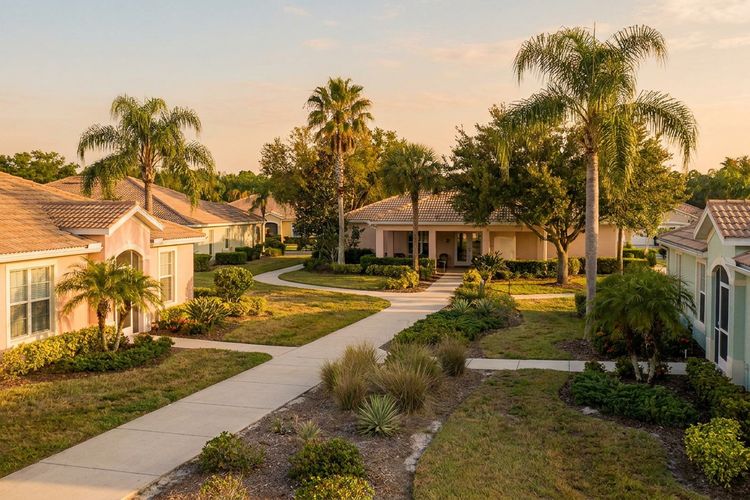
Florida has far more retirement-community choices than The Villages. The right alternative depends on what you want your days to look like: a walkable town center, a golf-and-club lifestyle, access to Gulf Coast beaches, a lower-maintenance resale home, or a community close to a major medical market. There is no universal winner, and a glossy amenity list cannot tell you whether a community fits your budget or healthcare needs.
This 2026 guide highlights seven Florida 55+ communities and active-adult neighborhoods worth researching besides The Villages. They are not ranked. Some have new construction, some are primarily resale markets, and some have limited or no new-home availability. Treat this as a shortlist for comparison, not a claim that any community is the cheapest or best for every retiree. For broader context, see our 25 Popular Retirement Communities in Florida and our Pros and Cons of Living in The Villages guide.
What to look for in a Florida 55+ community
Before comparing clubhouses and pickleball courts, decide which tradeoffs matter most. A community may be excellent for an active couple who wants organized activities but less suitable for someone who expects to need frequent specialist care or wants a quiet, low-fee neighborhood.
- Housing model: Ask whether homes are new, resale-only, condo, villa, or single-family. Check what the listing price excludes, including HOA dues, club fees, CDD charges, insurance, and taxes.
- Age rules: Confirm the community’s current rules for residents, guests, and caregivers. A “55+” label is not a substitute for reading the governing documents.
- Healthcare route: Map your preferred hospital, primary-care office, specialists, pharmacy, and emergency route. Medicare Advantage plan availability can change by county, so compare plans after you identify the exact address.
- Insurance and weather: Request a real homeowners-insurance quote, ask about flood zones, and check wind and storm requirements. Florida’s climate can affect the monthly budget more than a community’s brochure suggests.
- Daily-life fit: Test the drive to groceries, airports, beaches, libraries, worship, and family. A large amenity campus does not automatically mean a walkable neighborhood.
Seven Florida 55+ communities besides The Villages
1. On Top of the World – Ocala
On Top of the World is a long-established active-adult community in Ocala with a large menu of recreational activities. Its Central Florida location may appeal to retirees who prefer an inland setting, want access to Ocala’s equestrian and outdoor culture, and do not need to be on the coast.
The practical question is scale. A large community can make it easier to find clubs and activities, but it can also mean more driving within the development and more variation between neighborhoods. Ask which amenities are included with the home, which require separate memberships, and how resale homes differ by neighborhood. Visit at the time of year when you expect to live there rather than relying on a model-home tour.
2. Del Webb Catalina – Lakewood Ranch
Del Webb Catalina is a gated 55+ neighborhood within the larger Lakewood Ranch master-planned area near Sarasota and Bradenton. This is a good research candidate for buyers who want an age-restricted neighborhood but also value access to a broader master-planned community with shopping, dining, services, and medical resources nearby.
The tradeoff is that Lakewood Ranch is not a self-contained retirement town in the same way as some large active-adult developments. Compare the location of the community’s amenities with the larger area’s traffic, insurance costs, property taxes, and travel time to Sarasota-area healthcare. Ask for a complete monthly-cost sheet before comparing it with an inland community.
3. Cresswind Lakewood Ranch
Cresswind Lakewood Ranch is another 55+ village in the Lakewood Ranch area. Its resident-only clubhouse, fitness programming, pools, courts, arts space, and organized activities make it worth comparing with Del Webb Catalina if you are drawn to the Gulf Coast but want an active-adult setting.
Cresswind illustrates why retirees should compare the neighborhood and the surrounding region separately. The community may provide the social structure and amenities you want, while Lakewood Ranch supplies the larger area’s retail, healthcare, and cultural options. Price, HOA terms, builder incentives, and available inventory can change, so verify those details directly instead of using an old listicle or a national ranking.
4. Esplanade Golf and Country Club at Lakewood Ranch
Esplanade Golf and Country Club is a gated Lakewood Ranch neighborhood centered on an active resort and golf lifestyle. The community’s official site describes an 18-hole course, pools, fitness facilities, pickleball and tennis courts, dining, and organized activities. It may suit retirees who expect to use golf and club amenities often rather than treating them as occasional extras.
Golf communities require especially careful fee research. Ask whether golf is bundled, what the membership covers, whether food-and-beverage minimums apply, and how dues can change. Also compare the cost of a golf-oriented home with a nearby non-golf home. If you rarely play, paying for the lifestyle may not be sensible even if the neighborhood is attractive.
5. Latitude Margaritaville Daytona Beach
Latitude Margaritaville Daytona Beach is a recognizable 55+ active-retirement community near Daytona Beach with a resort and entertainment theme. Its official site currently says the Daytona Beach community is sold out. That makes it a useful example of a community to research on the resale market, but not a straightforward new-construction option.
For a resale purchase, ask which amenities transfer with the home, whether any capital contributions or transfer fees apply, and whether the seller’s monthly fee information is current. Coastal proximity can be appealing, but it also makes insurance, storm preparation, evacuation planning, and flood-zone research essential. Spend time in the surrounding area, not only inside the amenity campus.
6. Solivita – Kissimmee
Solivita is a gated 55+ community in Kissimmee, south of the Orlando area. The official site currently identifies the community as sold out for new homes, so buyers should treat it primarily as a resale-market option. Its Central Florida location may appeal to retirees who want organized amenities and access to the Orlando region rather than a beach-town setting.
Central Florida convenience is not the same as living close to every service. Check the actual drive to your doctors and preferred hospital, especially if you are moving from another state and have an established care team. Also compare the community’s rules, amenity fees, insurance, and reserves with other resale communities before assuming that a large amenity package represents better value.
7. Sun City Center and Kings Point
Sun City Center is an established 55+ community south of Tampa with a resident-run community association, clubs, recreation, and services. Within the broader area, Kings Point is a distinct active-adult community with its own amenities and management structure. This area is worth considering if you want an older, built-out community with an existing social network rather than a new development still taking shape.
Established communities can offer more resale choice and a mature amenity system, but they also require careful inspection. Review the age and condition of the home, roof, plumbing, electrical system, roads, pools, and clubhouses. Ask for current budgets, reserve studies, insurance information, pending assessments, and rules about rentals, renovations, golf carts, and pets.
Florida retirement costs that are easy to underestimate
Florida does not impose a personal income tax on individuals, according to the Florida Department of Revenue. That is a real attraction for many retirees, but it does not make every Florida community inexpensive. You still need to budget for federal income tax, property tax, insurance, utilities, sales tax, transportation, HOA or club dues, and healthcare spending.
For a qualifying Florida homestead, the Department of Revenue explains that the exemption may reduce taxable value by up to $50,000, subject to the law and county property-appraiser determination. It also notes that applications go through the county property appraiser. Do not build a purchase budget around an exemption until you confirm your eligibility, filing deadline, and projected county tax bill.
Insurance deserves its own line in your comparison. Request quotes using the actual address and construction details, then ask about wind, flood, roof age, deductibles, and non-ad valorem assessments. A community with a lower home price can still produce a higher monthly budget if insurance, dues, or special assessments are materially higher.
How to compare communities before buying
- Make a one-page budget. Include mortgage or rent, property tax, insurance, HOA, club or golf fees, utilities, transportation, healthcare, and a reserve for repairs.
- Read the documents. Request the declaration, bylaws, rules, current budget, reserve information, insurance summary, and any pending assessment notices.
- Check healthcare by address. Use Medicare’s Plan Compare and confirm your doctors, hospitals, prescriptions, and preferred pharmacies.
- Rent before buying when possible. A short stay during both a busy season and a quieter season can reveal traffic, noise, weather, and social-fit issues that a tour hides.
- Talk to residents who are not selling. Ask what they pay, what they wish they had known, how rule enforcement works, and whether the clubs and amenities are actually active.
Frequently asked questions
What is the best 55+ community in Florida besides The Villages?
There is no objective best community. Lakewood Ranch options may suit retirees who want Gulf Coast access and a larger master-planned setting. Ocala may appeal to people who prefer an inland location. Sun City Center may fit buyers who want an established community with extensive resident organizations. Compare the complete monthly cost, healthcare access, insurance, and daily-life fit rather than choosing by amenity count.
Does every 55+ community require every resident to be at least 55?
No. Rules vary. Florida law describes housing for older persons and includes requirements for communities operating as 55+ housing, including an 80-percent occupied-unit standard and published policies. Read the community’s current governing documents and ask how the rules apply to spouses, caregivers, and long-term guests.
Are Florida 55+ communities cheaper than regular neighborhoods?
Not necessarily. Some offer efficient homes and shared amenities, while others add HOA, club, golf, CDD, or special-assessment costs. Compare the full annual cost and obtain an insurance quote before deciding that a community is affordable.
Can I find healthcare and Medicare coverage near these communities?
Usually, but the relevant details depend on the exact county and address. Medicare Advantage plans may serve only selected counties, and providers can change. Check Medicare Plan Compare, call your doctors’ offices, and verify hospital and specialist access before signing a contract.
The bottom line
Florida’s 55+ alternatives range from large inland communities to Gulf Coast villages, established resale neighborhoods, and themed coastal developments. The best starting point is to identify your non-negotiables, shortlist two or three communities, and compare actual documents and costs. Tour the home, the surrounding area, and the healthcare route. Then decide whether the lifestyle still works when the brochure, the golf cart, and the first-year incentives are removed from the picture.

