


Updated for 2026. Short answer first: pickleball was almost certainly not named after a dog named Pickles. The strongest firsthand account says Joan Pritchard named the game after the “pickle boat” in crew — the leftover boat made up of oarsmen who weren’t picked for other boats. The dog story is catchy, widely retold, and useful for marketing. It is also the version the Pritchards later said got the timeline backward.
If you landed here wondering how pickleball got its name, you are not alone. The sport has gone from a bored-kids backyard experiment on Bainbridge Island, Washington, in 1965 to one of the biggest social-recreation habits in American retirement communities. Below is the clean version of the origin story, the competing name theories, and why the debate still won’t die.
Quick Answer: How Did Pickleball Get Its Name?
Most credible explanation: Joan Pritchard, wife of co-inventor Joel Pritchard, said the hybrid game reminded her of the pickle boat in crew — a boat filled with “leftovers” from other boats. Pickleball itself was assembled from leftover pieces of other sports: a badminton court, ping-pong-style paddles, a perforated plastic ball, and a tennis-like net height.
Popular alternative: The game was named after the Pritchard family dog, Pickles. Joel Pritchard later said the dog came after the game and was named for pickleball, not the other way around. USA Pickleball has also said its research supports the dog being born after the sport already had a name.
Bottom line: The pickle-boat story has the best firsthand claim. The dog story is the better folk tale. Both still circulate because the founders themselves did not always tell the story the same way.
Who Invented Pickleball?
Three Bainbridge Island friends are credited with inventing pickleball in the summer of 1965:
- Joel Pritchard — then a Washington state legislator, later a U.S. congressman and Washington’s lieutenant governor
- Bill Bell — a businessman and neighbor/friend in the Pritchard circle
- Barney McCallum — brought in the following weekend; helped shape early rules and paddle design
According to USA Pickleball’s official history, Pritchard and Bell came back from golf one Saturday to find their families sitting around with nothing to do. The property had an old badminton court, but they could not find a full set of rackets or a shuttlecock. They improvised with ping-pong paddles and a perforated plastic ball, started with the net at badminton height, then dropped it to about 36 inches once they realized the ball bounced well on asphalt.
McCallum joined the next weekend. The three men kept refining rules with a simple goal: make a game the whole family could play together. That family-first design is a big reason pickleball later thrived in 55+ communities — it is social, easy to learn, and less punishing than tennis for many older adults.

How Pickleball Got Its Name: The Two Main Stories
1. The Pickle Boat Story (Strongest Firsthand Account)
Joan Pritchard later explained that she named the game because it reminded her of the pickle boat in crew (rowing). In that tradition, the pickle boat was made up of leftover oarsmen who had not been chosen for other boats.
That metaphor fits the invention almost too well. Pickleball was not a pure new sport drawn on a blank page. It was a mash-up:
- Badminton court and original net height
- Table-tennis / paddleball-style paddles
- A Wiffle-style plastic ball
- A lowered net closer to tennis height
Washington’s nonprofit encyclopedia HistoryLink records Joan’s 2008 account of the pickle-boat explanation and notes that Joel Pritchard himself later treated the dog story as the more marketable myth, not the accurate origin.
2. The Dog Story (Popular, but Probably Backward)
The dog story says the game was named after Pickles, a family dog that chased loose balls. It is charming. It is easy to remember. And for years it got repeated as if it were settled fact.
The problem is the timeline. Joel Pritchard said the dog came later and was named after the game. In other words: pickleball first, Pickles second. USA Pickleball has also said its research supports the dog being born after the sport already had a name. That does not mean nobody ever had a dog involved with early play. It means the cute “named after the dog” version is likely a later rewrite of the origin.
Why did the dog story stick? Because it works. Joel Pritchard himself reportedly noted that people advised him to stick with the dog version because it “works better.” Marketing beat precision.
Other Name Theories You May Hear
Even among the founders, the naming lore was not perfectly unified:
- Barney McCallum was associated with a line about putting opponents “in a pickle.”
- Bill Bell has been linked to a similar “put them in a pickle” idea in later retellings.
- “Tenny pong” was reportedly considered as a temporary / alternative name.
- Authors of History of Pickleball: More than 50 Years of Fun! have said they could not close the dog-vs-boat debate with absolute certainty from every source they reviewed.
That last point matters. Honest history is messy. The best answer is not “everyone always agreed.” The best answer is: Joan Pritchard’s pickle-boat explanation is the strongest primary claim, and the dog story is the best-known alternative with a weaker timeline.

So Which Story Should You Believe?
If you want the version that best matches the inventors’ later corrections and Joan Pritchard’s own explanation, go with the pickle boat.
If you want the version your neighbor on the next court is most likely to tell you between games, you will still hear the dog story a lot. That is fine — just know it is folk history more than settled origin.
A practical way to remember it:
- Pickle boat = leftovers from other sports → strongest naming logic
- Pickles the dog = unforgettable mascot story → weaker chronology
Pickleball Origin Timeline: 1965 to Today
| Year | What happened |
|---|---|
| 1965 | Joel Pritchard, Bill Bell, and Barney McCallum invent the game on Bainbridge Island, WA. |
| 1967 | First permanent dedicated pickleball court is built (USA Pickleball cites Joel and Joan Pritchard’s Seattle-area home). |
| 1968 | Pickle Ball Inc. is incorporated to promote and sell the game (HistoryLink: Feb. 13, 1968). |
| 1972 | Pickle-Ball, Inc. continues commercial growth as demand spreads beyond the Northwest. |
| 1976 | First known tournament held in Tukwila, Washington. |
| 1984 | United States Amateur Pickleball Association organizes; first national rulebook published. |
| 1989 | The Villages, Florida builds its first permanent courts — an early signal of the retirement-community boom. |
| 1990 | Pickleball is being played in all 50 states. |
| 2019 | Professional tours launch; SFIA reports about 3.3 million U.S. players. |
| 2022–2025 | Explosive growth era. USA Pickleball cites an estimated 24.3 million U.S. players by 2025 and more than 100,000 USA Pickleball members; 2024 ends with about 15,910 courts in the USA Pickleball database. |
Why Retirees Care About a 1965 Backyard Game
The name debate is fun. The bigger reason this page gets traffic is simpler: pickleball became one of the default social sports of American retirement.
Compared with tennis, it is usually easier on the joints, quicker to learn, and more welcoming to mixed skill levels. Compared with golf, it is cheaper to start and easier to fill a last-minute foursome. In many 55+ communities, the courts are not a side amenity anymore — they are the afternoon social calendar.
That is especially true in Florida lifestyle hubs. If you are comparing communities with serious court culture, start with our guides to popular Florida retirement communities and the full 2026 take on pros and cons of living in The Villages.
What Pickleball Is, in Plain English
If you only know the name and not the game:
- Played on a badminton-sized court with a net a little higher than table tennis and lower than tennis
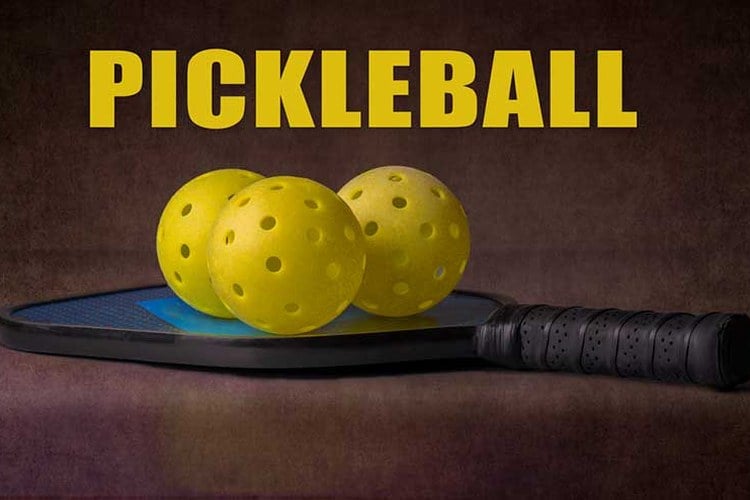
- Uses a solid paddle and a perforated plastic ball
- Usually doubles, though singles is common too
- Includes a non-volley zone near the net (the “kitchen”)
- Scoring and serving rules are simple enough that beginners can rally on day one
The kitchen rule is the part that confuses new players most. You generally cannot volley (hit the ball out of the air) while standing in that zone. It keeps big athletes from camping at the net and smashing everything — another reason the game stays friendly across ages.
Common Myths About the Name
Myth: It has something to do with pickles
No. There is no brine, no jar, and no snack sponsorship origin story. “Pickle” here points either to the pickle boat or to the everyday phrase “in a pickle.”
Myth: Everyone agrees it was the dog
They don’t. The dog story is popular, not settled. Joel Pritchard himself pushed back on it later.
Myth: Pickleball is brand-new
The boom is recent. The invention is not. The game is about 60 years old as of 2025–2026. What changed is scale: TV coverage, pro tours, community court construction, and retirement-community adoption.
FAQ: How Pickleball Got Its Name
Was pickleball named after a dog?
Probably not. The better-supported account is that the game was named first and the dog Pickles came later. The dog story remains popular because it is memorable.
What is a pickle boat?
In crew/rowing lore, a pickle boat is the boat filled with leftover oarsmen who were not selected for other boats. Joan Pritchard said the hybrid sport reminded her of that “leftovers” idea.
Where was pickleball invented?
On Bainbridge Island, Washington, at the Pritchard family’s summer home in 1965.
Who named pickleball?
Joan Pritchard is the person most consistently credited with coining or proposing the name, especially in the pickle-boat version of the story.
Is pickleball still growing in 2026?
Yes. USA Pickleball’s history timeline cites an estimated 24.3 million U.S. players by 2025 and more than 100,000 USA Pickleball members, after several consecutive years as one of America’s fastest-growing sports. Court supply is still catching up in many towns.
Why is pickleball so popular with retirees?
Low barrier to entry, built-in social time, mixed-skill doubles play, and wide availability in active-adult communities. You can be useful on a court much faster than in tennis or golf.
Watch a Short History Recap

The Bottom Line
Pickleball got its quirky name the same way it got its rules: by improvisation. The cleanest origin story is Joan Pritchard’s pickle-boat explanation. The dog story is the version that refuses to leave the party. Either way, a 1965 backyard experiment on Bainbridge Island turned into one of the defining social sports of modern retirement.
If you are scouting places where the courts stay busy after lunch, keep going with:
- 25 Popular Retirement Communities in Florida
- Pros and Cons of Living in The Villages, Florida (2026 Guide)
- Affordable Retirement Communities in Florida
Sources for this 2026 refresh include USA Pickleball’s official history timeline, HistoryLink essay 20195 on Joel Pritchard and Pickle Ball Inc., and cross-checked secondary summaries of Joan Pritchard’s pickle-boat account. Participation numbers are association-reported estimates.

