


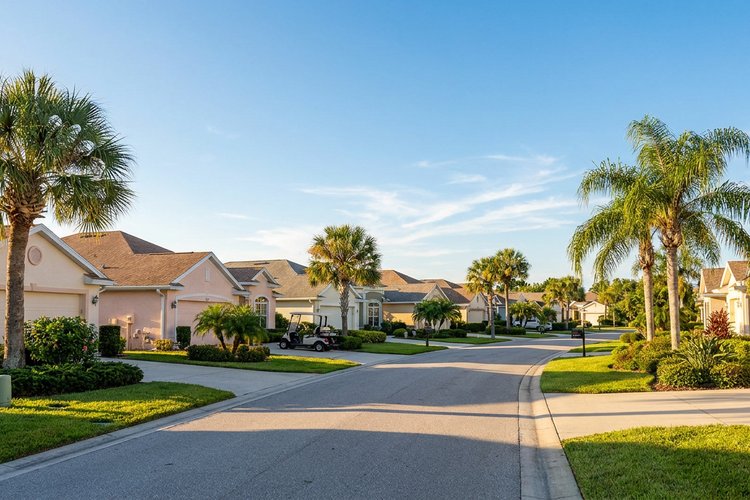
Updated for 2026: The Villages can make retirement feel unusually convenient, but the monthly cost is not just the home price. You also need to understand the amenity bill, district assessments, utilities, insurance, golf-cart costs, healthcare choices, and the lifestyle spending that comes with a very active community.
This guide is designed for people comparing The Villages with other retirement communities or deciding whether to rent before buying. It uses current official information where available and treats the numbers as planning inputs, not a promise of what any specific home will cost.
The short answer: is The Villages affordable in 2026?
It can be, especially for a household that owns its home without a mortgage and makes regular use of the included recreation. But “affordable” depends heavily on the neighborhood, the home’s age and insurance profile, whether you buy or rent, and how much you spend on restaurants, clubs, golf-cart travel, travel, and healthcare.
The most useful way to budget is to separate fixed housing costs from community costs and personal lifestyle costs. Do not compare only a listing price with your current mortgage. Ask for a recent utility and amenity bill for the specific property, request the annual tax bill, get an insurance quote, and price your healthcare options before making an offer.
The main costs of living in The Villages
1. Home price, mortgage, or rent
Home prices vary by village, lot, home type, age, updates, and location relative to commercial centers and recreation facilities. A mortgage payment may be the largest line in the budget, but a cash buyer still has property taxes, insurance, maintenance, utilities, district charges, and replacement reserves.
The Census Bureau’s 2020-2024 QuickFacts data for The Villages CDP reports a median value of owner-occupied housing units of $400,100, median selected monthly owner costs of $1,755 with a mortgage, and $645 without a mortgage. Those are community-level estimates, not a quote for a particular home, and they cover a period rather than a single 2026 purchase.
2. The monthly amenity fee
The amenity fee is one of the costs that makes The Villages different from an ordinary subdivision. The Community Development Districts say the contractual fee funds services and facilities including recreation centers, pools, public safety, Community Watch, gate and postal-station facilities, water-retention areas, and executive-golf-course operations and maintenance. The fee is billed monthly and may be adjusted under the contract using the Consumer Price Index.
Do not rely on an old article’s quoted fee. Ask the seller or district billing office for the current amount tied to the address. Homes in different districts or areas can have different bills, and a marketing page for a new rental or home may bundle several services into a single advertised total.
3. Maintenance assessments and district charges
A maintenance assessment is not the same thing as the amenity fee. According to the district FAQ, maintenance assessments can pay for items such as roads, landscaping, streetlights, multi-modal paths, stormwater and retention facilities, insurance, and management. The assessment appears on the property-tax bill under non-ad valorem charges.
When comparing homes, request both the latest property-tax bill and the district information for that home. A newer area, a different district, or a home with a bond obligation can change the total even when two houses have similar asking prices.
4. Utilities and sanitation
Water, wastewater, irrigation, trash, electricity, internet, and other services are separate from the home price. Some of these appear on the convenient monthly district bill. The district says sanitation, amenity, water, sewer, and irrigation fees are charged year-round, even when a property is vacant. Its FAQ currently lists residential sanitation fees of $22.97 per month for Districts 1-11 and $28.75 per month for Districts 12-16; verify the current charge and district before using those figures in a budget.
Summer air-conditioning use, irrigation, pool equipment, and the size and efficiency of the home can matter more than a generic “average utility bill.” The district’s rate-information page links current 2026 water and sewer rate documents by service area, which is a better starting point than a national cost-of-living calculator.
5. Golf-cart costs
Residents receive waived green fees on the executive courses, but a golf cart is not free. The district states that an Executive Golf Trail Pass is required to use a personal golf car on the courses. Its current published prices, excluding tax, are $21.77 for one month, $107.77 for six months, and $143.70 for 12 months. Prices can change.
Budget for the cart itself, insurance if applicable, charging, tires, batteries, repairs, storage, and replacement. If you do not plan to golf, you may still want a cart because it can be practical transportation within the community. That is a lifestyle choice, not an automatic saving.
A practical 2026 budgeting worksheet
Use this worksheet for the exact home you are considering. Put in real quotes where possible rather than broad internet estimates.
| Budget category | What to verify |
|---|---|
| Housing | Mortgage or rent, property taxes, maintenance, and replacement reserve |
| Insurance | Homeowners, wind, flood, auto, and any required coverage |
| District costs | Amenity fee, maintenance assessment, bonds, and other non-ad valorem charges |
| Utilities | Electric, water, sewer, irrigation, trash, internet, and phone |
| Transportation | Golf cart, car, fuel, repairs, insurance, and airport or medical trips |
| Healthcare | Medicare premiums, plan cost-sharing, prescriptions, dental, vision, and travel care |
| Lifestyle | Dining, clubs, events, golf-cart upgrades, shopping, gifts, and travel |
| Reserve | Roof, HVAC, appliances, storm repairs, deductibles, and unexpected assessments |
For a debt-free comparison, start with the Census benchmark of $645 in median monthly owner costs without a mortgage, then add the property-specific district charges, insurance, utilities, healthcare, transportation, and lifestyle spending. Do not treat that $645 as an all-in cost.
Florida taxes and what they do – and do not – save
Florida does not impose a personal income tax, according to the Florida Department of Revenue. That can be helpful for retirees with taxable retirement income, but it does not eliminate taxes and ownership costs. Florida sales tax, local property taxes, insurance premiums, assessments, and everyday spending still matter.
For a property-tax estimate, ask the county property appraiser how exemptions and portability may apply to your situation. Never assume the seller’s current tax bill will be your bill after a purchase. The assessed value, exemptions, homestead status, and purchase-related reassessment can change the result.
Healthcare in The Villages: convenient, but check the network
The Villages has a substantial local healthcare presence, including The Villages Health. Its Medicare-resources materials explain that the system works with selected Medicare Advantage plans and that plan participation is a key part of how patients access its care model. That may be attractive if your preferred doctors, hospitals, prescriptions, and specialists fit one of those plans.
It is not a reason to choose a plan without comparing it. Before moving, check your ZIP code in Medicare’s official Plan Compare tool. Confirm doctors, hospitals, specialists, prescription formularies, referrals, out-of-network rules, dental and vision coverage, maximum out-of-pocket exposure, and what happens when you travel or spend part of the year elsewhere.
Original Medicare with a Medigap policy and Part D may fit one household better, while Medicare Advantage may fit another. The right answer depends on health needs, travel, medications, risk tolerance, and the local provider network – not simply on whether a community has an attractive medical campus.
Who is most likely to like The Villages?
- Retirees who want a dense calendar of organized activities and easy social contact.
- People who will use pools, recreation centers, pickleball, walking paths, and executive golf often enough to justify the recurring community costs.
- Households comfortable planning around a car-and-golf-cart lifestyle.
- Buyers who can obtain acceptable insurance and understand the district bill before closing.
- People willing to compare Medicare networks rather than assuming local convenience guarantees preferred coverage.
Who should be cautious?
- Anyone whose budget works only if insurance, utilities, or assessments remain unusually low.
- Retirees who want a traditional town center, public-transportation-first lifestyle, or more cultural variety outside the community.
- People who dislike recurring amenity fees or do not plan to use the facilities that fee supports.
- Those with doctors, medications, or travel patterns that do not fit the available Medicare networks.
- Buyers who are uncomfortable with Florida heat, storms, insurance volatility, or the possibility of future district and home-maintenance costs.
A due-diligence checklist before you buy
- Request a recent utility and amenity bill for the exact address.
- Request the latest property-tax bill and all non-ad valorem assessments.
- Ask whether the property has a bond balance, maintenance obligation, or district-specific charge.
- Get homeowners, wind, flood, and auto insurance quotes before the inspection period expires.
- Ask for roof age, HVAC age, plumbing history, and recent repair records.
- Price a golf cart, trail pass, charging, insurance, and battery replacement.
- Check your doctors, hospitals, prescriptions, and Medicare options at your future ZIP code.
- Rent for a trial stay if you are unsure about the pace, weather, traffic, and social environment.
- Keep a cash reserve for deductibles, repairs, travel, and future assessments.
FAQs about The Villages cost of living and healthcare
How much is the amenity fee in The Villages in 2026?
There is not one safe number to apply to every home. The fee is contractual, billed monthly, and may be adjusted using the Consumer Price Index. Ask for the current fee tied to the property and district instead of relying on an older article or a marketing estimate.
Does the amenity fee include golf?
Residents receive waived green fees on the executive courses, but a trail pass is required to use a personal golf car on those courses. The district lists trail-pass prices separately, and prices are subject to change.
Is healthcare free in The Villages?
No. Healthcare costs still include Medicare premiums, plan cost-sharing, prescriptions, dental and vision care, and services that fall outside your coverage. The Villages Health also works with selected Medicare Advantage plans, so compare the network and total annual exposure before enrolling.
Is The Villages good for retirees on Social Security?
It may be, but the answer depends on housing, insurance, and lifestyle spending. Build a budget from your actual Social Security income, pension or portfolio withdrawals, taxes, healthcare, and a repair reserve. A home that looks manageable before insurance and district charges may not fit once all recurring costs are included.
Should I rent before buying in The Villages?
Renting first is sensible if you have not experienced the heat, storm season, golf-cart traffic, distances between villages, healthcare options, and social calendar. Use the trial stay to record real grocery, dining, transportation, utility, and activity spending rather than treating it as a vacation.
Bottom line
The Villages can deliver a lot of recreation and social infrastructure for the money, but the advertised home price is only the beginning. In 2026, the responsible comparison is an address-level budget that includes the district bill, maintenance assessment, taxes, insurance, utilities, golf-cart costs, healthcare, and the lifestyle you actually expect to live.
For a broader look at the tradeoffs, read our pros and cons of living in The Villages. If you are comparing alternatives, see our guide to 55+ communities in Florida besides The Villages and our The Villages weather guide.
